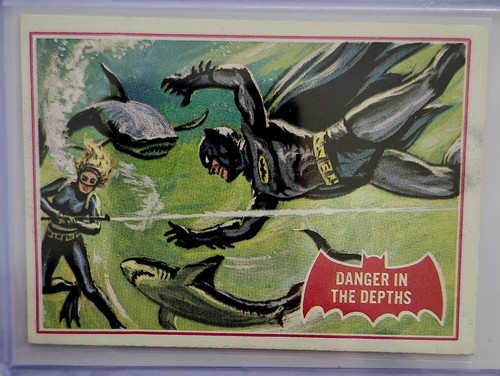
1966 Topps Batman Red Bat #14A Danger in the Depths — Raw
This card in every grade
| Holder | Listed | Cheapest | Dearest |
|---|---|---|---|
| Raw | 14 | $3.69 | $14.50 |
| TAG ? | 3 | $9.98 | $19.99 |
| PSA 1.5 | — | — | — |
| CGC 2 | 1 | $23.99 | — |
| BVG 6.5 | 1 | $78.21 | — |
Asking range
Confirmed sales
| Date | Price | Basis | Listing |
|---|---|---|---|
| 2026-09-15 | $1.99 | HIGH · final bid | 1966 Topps Batman Series A (Red Bat Logo) #14A Danger in the Depths |
| 2026-09-12 | $7.50 | HIGH · final bid | 1966 Topps Batman A Series (Red Bat Logo) Danger in the Depths #14A |
| 2026-08-31 | $10.50 | HIGH · final bid | 1966 Topps Batman A Series (Red Bat Logo) Danger in the Depths #14A |
| 2026-08-16 | $4.00 | HIGH · bin asking | 1966 Topps Batman Red Bat - #14A "Danger in the Depths" VG-VGEX |
Live listings


Index grading notes

Centering estimate: left border appears noticeably wider than right (roughly 65-70% left / 30-35% right horizontally); top and bottom borders appear more balanced, approximately 55/45 top-heavy - centering is off but not catastrophically so. Corners are difficult to assess precisely through the sleeve glare but the upper-left and lower-left corners appear to show some rounding/softening consistent with VG-EX to EX range; the right-side corners are partially obscured by glare. Surface shows what appears to be a horizontal crease or stress line running across the mid-section of the card (visible as a subtle line separating the upper and lower image panels), which if confirmed would cap this at VG-EX (4) or lower. Gloss appears partially intact but muted, consistent with moderate handling wear. Without a clean back view and corner macro shots, the range is widened; the possible crease across the center is the key concern dragging the estimate toward the lower end of the range.

Centering estimate: left border appears narrower than right (roughly 70/30 L/R favoring right), top border slightly wider than bottom (approximately 60/40 T/B) - centering is off but not miscut territory. Most critically, there is a clearly visible horizontal crease running across the mid-section of the card face, which is the dominant grade-limiting defect and alone caps this card at PSA 3 or below. Corner assessment through sleeve shows moderate-to-heavy rounding on at least the visible corners, consistent with a VG card. Surface gloss appears diminished with some wear. The crease combined with corner rounding and gloss loss points firmly to VG (3) with VG-EX (4) as an optimistic ceiling only if the crease is shallower than it appears through the sleeve.

Card is inverted in the photo, making precise corner and edge assessment difficult. Centering estimate (reading the image corrected): left/right borders appear approximately 70/30 favoring one side, top/bottom roughly 60/40 — centering is noticeably off but not catastrophically so, consistent with PSA 4-5 range. All four corners show visible rounding with no sharp points remaining, consistent with VG to VG-EX wear; no corners appear fully blunted to a GOOD level. Surface gloss appears partially intact with some loss visible, and there is a possible light surface crease or handling line near the center of the card that cannot be confirmed definitively due to image orientation and resolution — if a crease is confirmed, the grade floors at 3. No tears, writing, or staining are apparent. The seller's VG-EX self-assessment aligns with the visible evidence; PSA 4 (VG-EX) is the most likely landing spot, with PSA 3 possible if the suspected crease is real and PSA 5 possible if corners are better than they appear inverted.

Centering estimate: left border appears slightly wider than right (~55/45 L/R), top border visibly wider than bottom (~60/40 T/B) — centering is acceptable for a mid-grade vintage card, no OC concern. Corners appear lightly worn with minor rounding visible especially at bottom-left and top-right, consistent with EX to EX-MT range. Surface shows solid color saturation and reasonable gloss retention with no obvious creases or staining visible; minor print texture/snow is normal for this issue. The COMC watermark obscures the center of the card surface, making a definitive surface-condition call impossible — back not visible and corner closeups unavailable, so the range is widened accordingly.

Centering estimate: left border appears approximately 10-12% wider than right border (roughly 60/40 L/R), top border slightly wider than bottom (roughly 55/45 T/B) — centering is acceptable for mid-grade vintage. Corners appear reasonably sharp with no obvious heavy rounding visible at this resolution, suggesting EX-MT to NM range, though the COMC watermark obscures fine corner and surface detail. White borders show mild toning consistent with a 55+ year old card but no obvious creases or staining are visible. Surface gloss appears present but cannot be fully assessed due to the watermark overlay; edge texture looks period-normal for 1966 Topps rough cuts and is not penalized.

Centering estimate: left border appears slightly wider than right (~55/45 L/R), top border noticeably narrower than bottom (~60/40 T/B) — centering is imperfect but not severely off-center. Seller title notes 'corner wear' and 'staining,' and the note bar at the bottom confirms both defects; corner wear is consistent with rounded or soft corners placing this in the VG-EX to VG range. The COMC watermark obscures surface detail somewhat, making it difficult to fully assess gloss loss or crease presence. Staining noted by seller is a meaningful surface defect; if a visible crease is also present (not clearly confirmable through watermark), grade would lean toward 2-3; absent a crease, a soft 4 is possible, but the combination of corner rounding and staining most likely lands this at PSA 3.

Centering estimate: left border appears noticeably wider than right (approximately 65-70/30-35 L/R), top and bottom borders appear more balanced at roughly 55/45 T/B — centering is off but not extreme. The most significant concern is visible surface creasing in the upper left quadrant of the card face, consistent with the seller's 'READ!' flag suggesting disclosed flaws; the crease appears moderate and catches light. Corners show rounding consistent with a VG to VG-EX range — no razor sharpness on any corner visible from this distance. Surface gloss appears largely gone with some toning on the white border areas, consistent with age and handling. The toploader makes precise corner and edge assessment difficult, and the back is unseen, but the crease alone is likely to cap this card in the PSA 2-3 range; a grade of 3 (VG) is the most probable outcome given the visible crease, corner rounding, and gloss loss.

Centering estimate: left border appears narrower than right (~60/40 L/R), top border slightly narrower than bottom (~55/45 T/B) — modest but not severe miscentering. A visible horizontal crease or stress line runs across the middle of the card (approximately mid-card, consistent with a fold crease), which is the most grade-limiting defect here and likely caps this card at EX (5) or below. Corners appear to show light-to-moderate rounding — no razor points visible, consistent with a VG-EX to EX range. Surface gloss appears partially intact but the crease disrupts the surface meaningfully. The crease alone pushes this below NM territory; if it is a hard crease rather than a surface wrinkle, the grade could fall to 4 (VG-EX); if it is a softer impression, EX (5) is reachable.

Centering estimate: left border appears noticeably wider than right (roughly 70/30 L-R), top border slightly wider than bottom (approximately 60/40 T-B), so centering is off but not severely miscut - no adjacent card printing visible. Corners show visible rounding on at least two corners (lower-left most apparent), consistent with VG-EX to EX range. There is a visible horizontal crease/fold line running across the mid-section of the card (clearly visible cutting through the image area), which is a significant surface defect that pushes the grade down; if confirmed as a full crease rather than a printing artifact, this likely caps the grade at 3-4. Surface gloss appears partially intact with some loss, and the white borders show moderate toning. The crease is the dominant grade-limiting factor here - without it the card might grade EX(5), but with it VG(3) to VG-EX(4) is the realistic range.

Centering estimate: left border appears wider than right (roughly 60/40 L/R), top border slightly wider than bottom (roughly 55/45 T/B) — centering alone is not catastrophic. However, there is a clearly visible diagonal crease running across the lower-center portion of the card face, which is a hard grade-capper; a second horizontal stress line is also apparent near mid-card. Corner wear is evident on all four corners with rounding visible even at this resolution, suggesting heavy handling. Surface gloss appears largely lost, consistent with a VG or lower grade; the crease alone pushes this below EX territory. Overall condition aligns with GOOD (2) to VG (3), with the crease and corner rounding being the primary detractors.

Centering estimate: left border appears narrower than right (roughly 60/40 L/R favoring right), top border slightly narrower than bottom (roughly 55/45 T/B) - centering is off but not catastrophically so, no miscut detected. Corners show visible rounding on at least two corners visible in frame, consistent with VG-range wear. Surface shows some gloss loss and what appears to be light toning on the white border areas, consistent with age. The seller's self-described 'VG' grade aligns with observations - rounded corners and gloss loss place this firmly in PSA 3 territory, with a slight chance of reaching 4 VG-EX if corners are better than they appear under the sleeve; back is unseen and could reveal creases or staining that would push toward a 2.